


Peec AI is worth considering if you want daily AI Search monitoring, competitor comparisons and a way to investigate the sources behind answers. An alternative becomes useful when you need a different reporting setup, a particular engine or market, separate reporting for more clients, or content tools alongside analytics.
If you already use Peec, check whether an upgrade, extra model or connected tool solves the problem before switching. If you are buying your first platform, compare prices for the engines, client projects and reporting access you need.
Superlines publishes this guide and is included below. The comparisons draw on vendors' product documentation and pricing, checked on 16 October 2026. Fit recommendations are editorial judgments, not results from a controlled product test.
TL;DR: when Peec fits and when to compare alternatives
What Peec AI already does well
Peec's performance dashboard brings together daily visibility trends, competitor comparisons, sentiment, position and recorded answers. You can move from a change in a chart to the questions and responses behind it. That is useful when a monthly report needs an explanation, not just a score.
Its source analysis helps you inspect domains and URLs associated with answers. Its Brand Perception features examine attributes, recurring objections and factual claims against information you supply about your brand. These support different decisions: being described negatively is different from being described inaccurately.
Peec also documents recommended actions, an agent and reporting integrations, giving teams ways to explore findings and take them into their work.
Compare the right Peec plan first
Peec's brand plans are advertised at €85/month for Starter, €205 for Pro and €425 for Advanced on monthly billing. They include 50, 150 and 350 prompts respectively, three selected models, and one, two or five projects. Advanced lists multi-country tracking and Looker Studio; custom Enterprise lists API access and SSO. Additional models are available as add-ons.
Agency plans use pooled credit allocations across client projects, with separate client and reporting features. Essential, Growth and Scale are advertised at €205, €425 and €675 monthly. The model mix and tracking frequency affect how many prompts an allocation supports.
Peec AI alternatives at a glance
Some subscriptions limit how many questions you can track, while others count the AI answers collected. Content agents may use separate credits. Compare the total cost for the AI platforms, client projects and reports your team needs.
Alternatives for different reporting and workflow needs
Superlines: analytics and recommendations across brands and markets
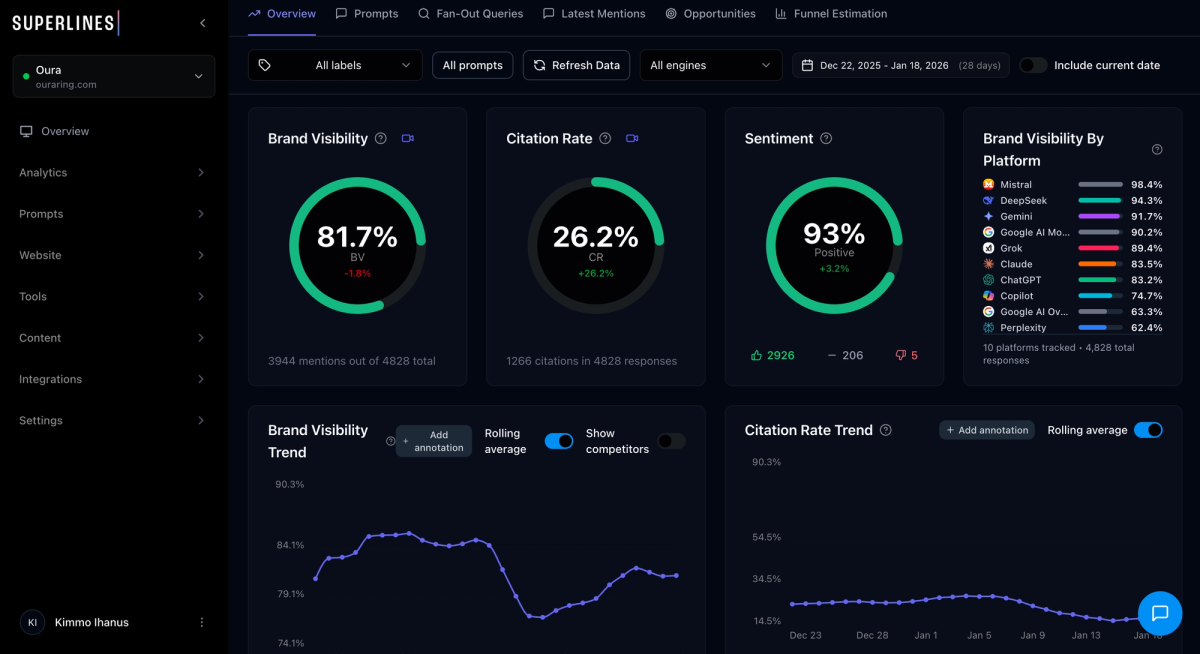
Superlines helps marketing teams and agencies investigate visibility, citations, sentiment and competitors across AI Search engines. You can inspect cited pages and recorded additional searches behind an answer, then use the Action Center to prioritize content, technical or outreach recommendations.
Superlines brings findings from multiple brands into one place for client and management reporting. Your team can investigate results in the dashboard, use exports to build reports and ask a compatible AI assistant questions about the data.
Starter package is €79/month, with 50 prompts, one brand and three selected engines. Pro is €199/month with 150 prompts, three brands and data exports. Growth is €379/month with 300 prompts, seven brands and API access. Agency packages list five, ten and twenty client brands at those respective tiers. A plan can support your full client list but still include too few prompts to track the questions you need.
MCP access on every plan lets compatible AI assistants query the data. API access lets other reporting systems retrieve it automatically. Starter includes one month of history, Pro two and Growth six. If you need year-over-year comparisons, consider Enterprise's all-time history or confirm how you'll preserve historical reports outside the platform.
OtterlyAI: a lower-cost starting point for a small monitoring set
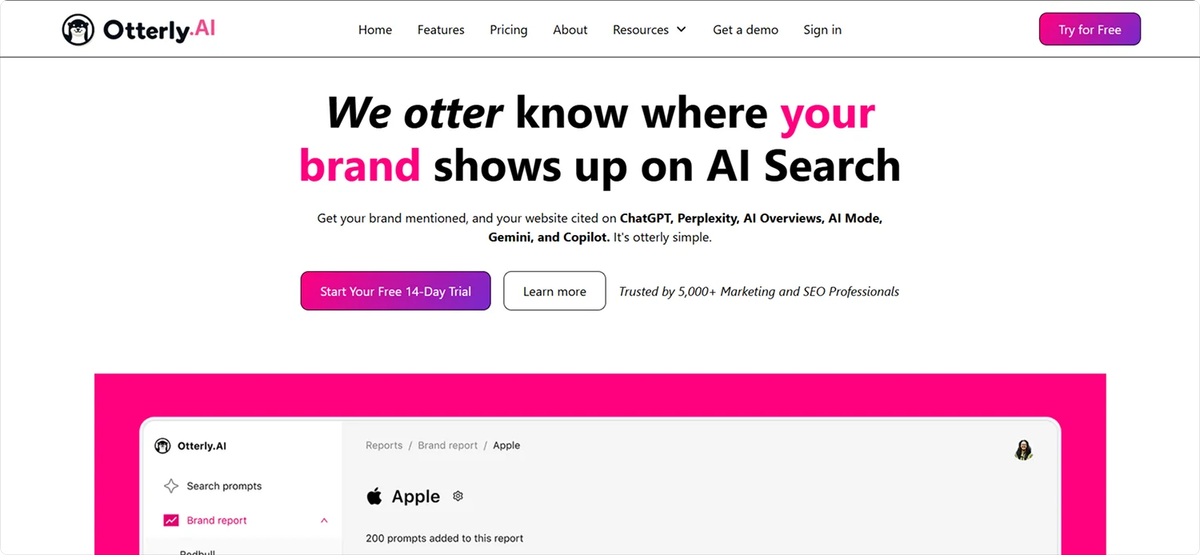
OtterlyAI is worth evaluating when you need recurring visibility, sentiment and citation monitoring for a small set of questions. Lite costs $29/month for 15 prompts checked daily across ChatGPT, Google AI Overviews, Perplexity and Microsoft Copilot. It includes reports and exports.
That can suit a focused pilot whose question set fits the allowance. Peec Starter covers more prompts, so the entry prices alone do not establish which is cheaper for your work. Otterly's Standard plan is $189/month for 100 prompts; Premium is $489 for 400.
Engine selection is the main spending detail to watch. Claude, Google AI Mode and Gemini are paid add-ons. Standard and Premium also list API, MCP and a Data Studio connector, with usage limits. If you need one of those engines or automated reporting, price that configuration before choosing Lite on cost alone.
Promptwatch: entry-level data access, with content tools on higher plans
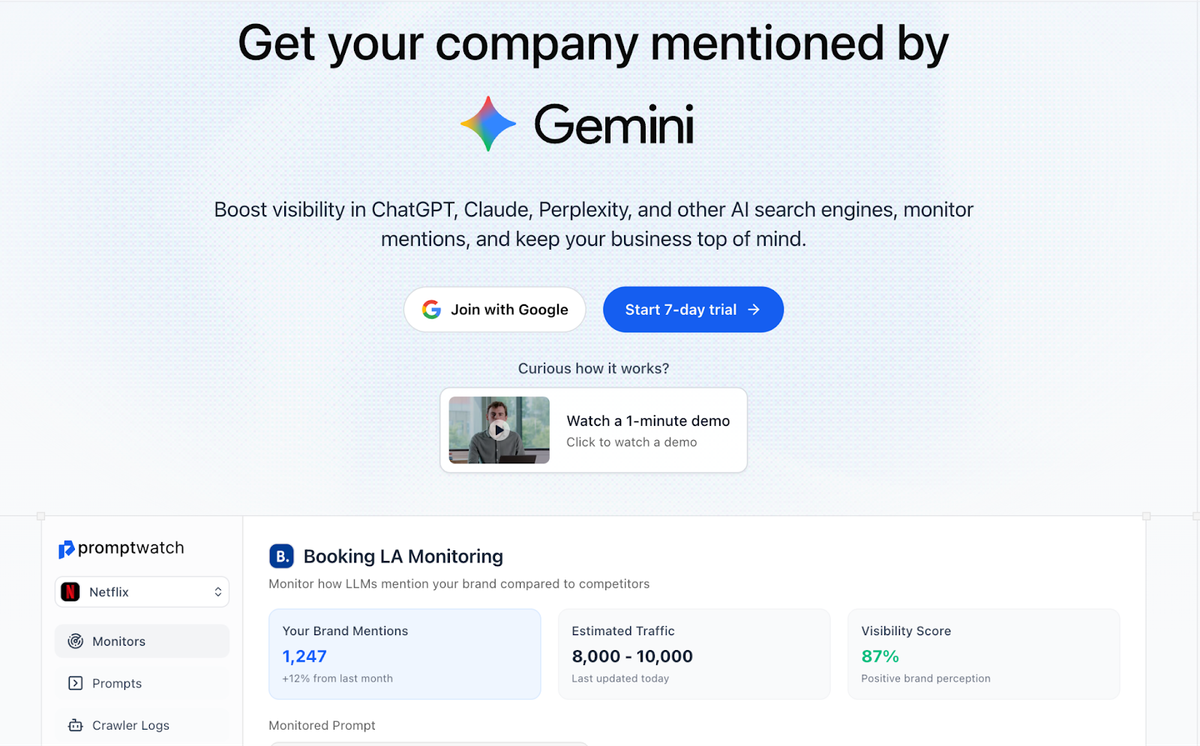
Promptwatch Essential costs $95/month for 50 prompts, four models and one project, including API and MCP access. This makes it worth comparing when an automatic reporting connection is central to the job and Peec's Enterprise route is more than you need.
Promptwatch also documents content agents and CMS integrations. A content team can investigate gaps, prepare articles or refreshes, and send drafts or posts to a connected CMS. That is a different workflow from buying analytics and assigning the resulting work to an existing writer.
Essential includes no AEO articles. Professional is $245/month with 150 prompts, two projects and five articles per month; it also lists Agent Analytics. Business is $579/month and adds state/city tracking among its expanded features. Article allowances and agent credits are separate from monitoring capacity.
AthenaHQ: response analysis with content optimization workflows
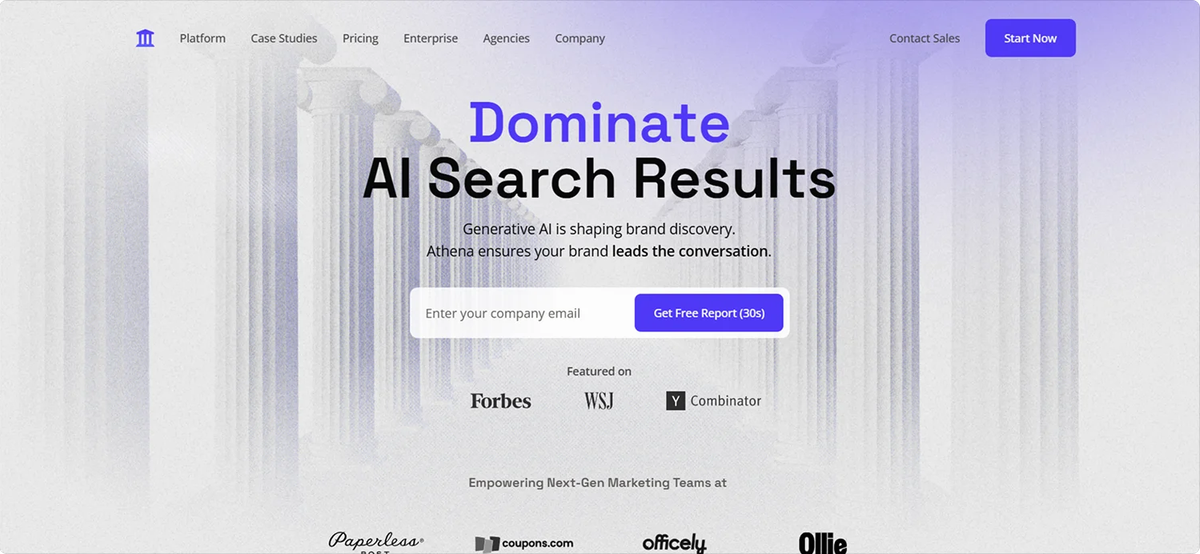
AthenaHQ combines competitor and citation analysis with recommendations and content optimization agents. It is relevant when the team wants to investigate an AI answer and carry the resulting content work further inside the same product.
Starter costs $295/month and includes 3,600 credits, CSV export, on-page/off-page actions and a content optimization agent. The vendor defines one credit as one AI response. Running questions across several models uses the allocation differently from tracking the same number of questions on one model.
API access is a paid Starter add-on, with pricing supplied separately. Enterprise adds custom allocation, multiple regions/languages, access controls and broader reporting support. For an international team, those package boundaries matter as much as the list of supported engines.
Profound: tailored enterprise tracking and broader marketing workflows
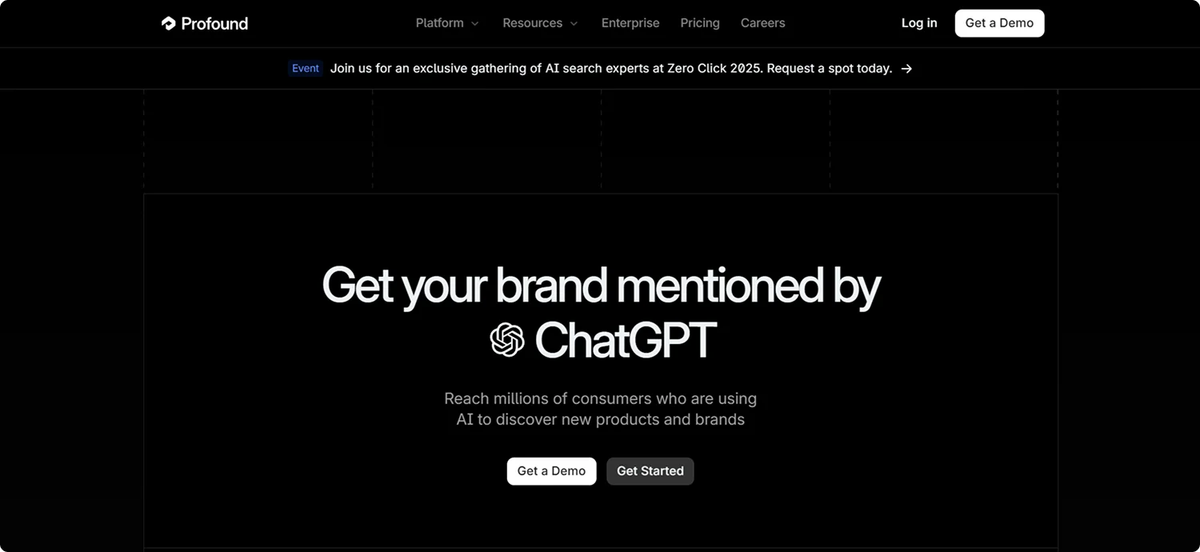
Profound combines answer monitoring with shopping analysis, agent analytics and an AI Marketer for research, writing and repeatable marketing workflows. It belongs on the shortlist when those jobs need to work together, especially for a larger team evaluating product visibility or automating recurring research and writing.
Its public brand pricing presents a free Trial and custom Enterprise packages. The Trial runs 50 prompts daily for seven days across ChatGPT, Gemini and Google AI Overviews. Ongoing coverage, volume and access are tailored; the trial is not a recurring low-cost subscription. Agencies can also use a separate Agency Growth subscription with paid ongoing client workspaces. Pitch workspaces support short-term prospect audits; they do not replace ongoing client monitoring.
If you need dedicated analytics without the wider workflow, keep that narrower requirement in the comparison. Our Profound alternatives guide explores that buying decision in more depth.
Scrunch: connect answer monitoring with page and agent diagnostics
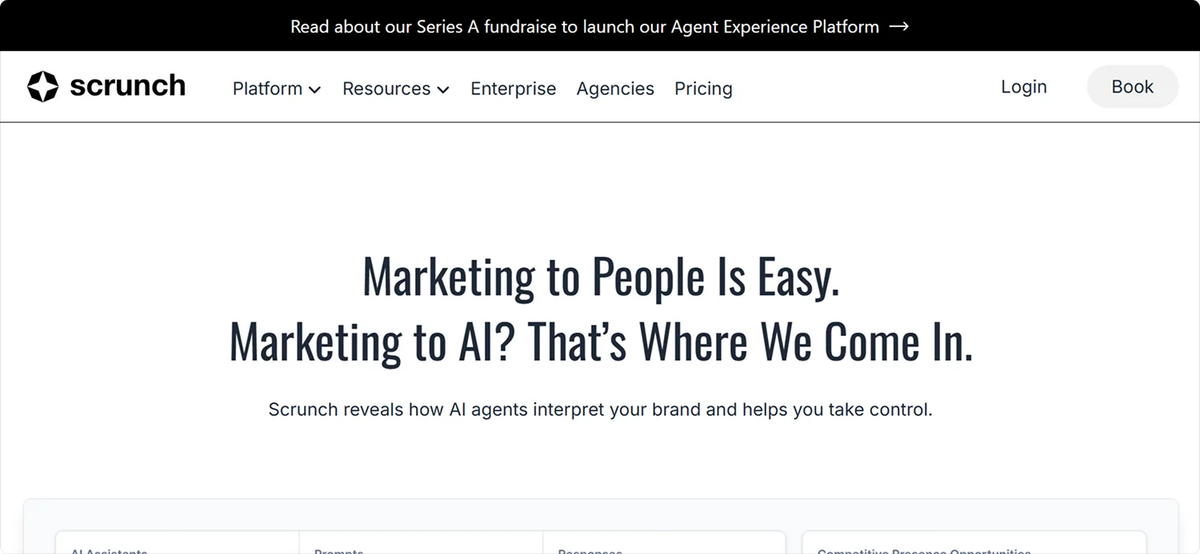
Scrunch combines prompt monitoring and citations with personas, page audits and agent traffic monitoring. It is worth evaluating when you want to examine the pages AI systems encounter alongside the answers being recorded.
Starter costs $300 month-to-month, or $250 per month billed annually. It includes 350 custom prompts, three users and five page audits. Growth is $500 monthly or $417 per month billed annually. Enterprise includes the Enterprise Data API and expanded access and support.
Scrunch also describes AXP, its Agent Experience Platform, which creates an AI-friendly version of a site for agent experiences. Treat that as a separate implementation decision: establish the pages involved, delivery setup and package before including it in a comparison with monitoring alone.
Page audits can identify problems worth fixing, but they do not guarantee a change in an AI answer or citation.
Writesonic: tracking alongside writing and SEO audits
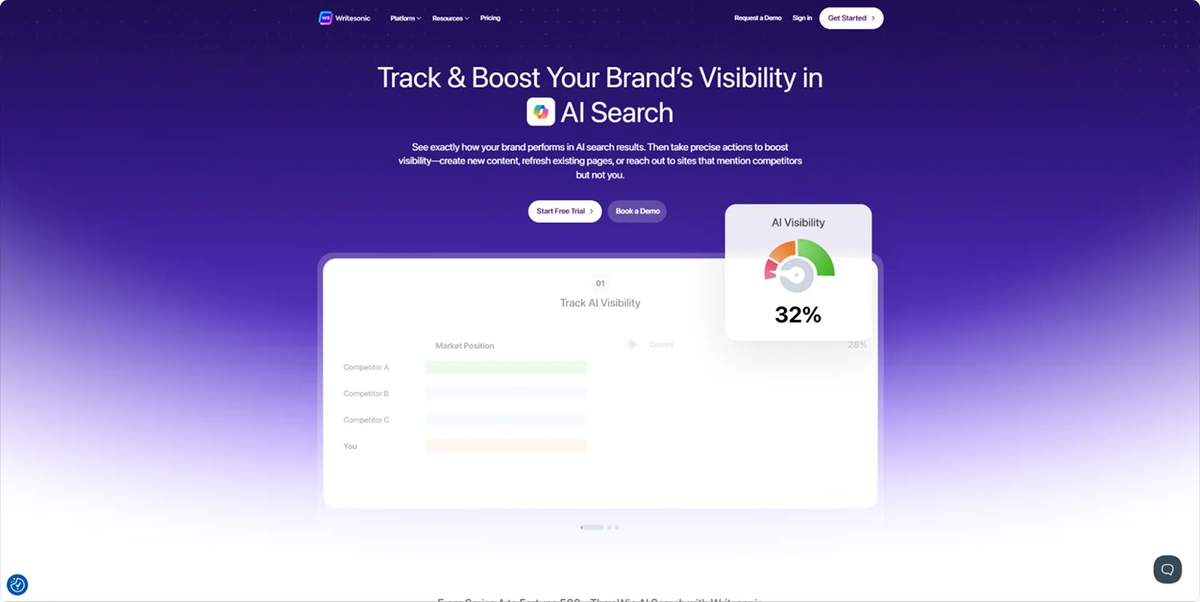
Writesonic is a relevant option when the person investigating visibility also needs to produce articles and audit pages. Its published plans combine those jobs, which may reduce handoffs for a small content team.
The advertised annual offers are Starter at $79/month, Basic at $199 and Growth at $399, billed annually. Starter lists 50 prompts, 15 AI articles per month, one user and one project. Its named tracking platforms are ChatGPT, Gemini and Google AI Overviews. Broader coverage is listed on Enterprise.
Growth includes sentiment analysis and a limited Action Center trial; Enterprise lists the full Action Center. Do not assume every optimization workflow is included without limits in a self-service plan.
Compare Writesonic with Peec plus your writing tools if those are the jobs you want to combine. If you already have a writing and approval process that works, its included articles may add less value than better-fitting monitoring coverage.
Semrush: assess the AI capabilities in your existing SEO account
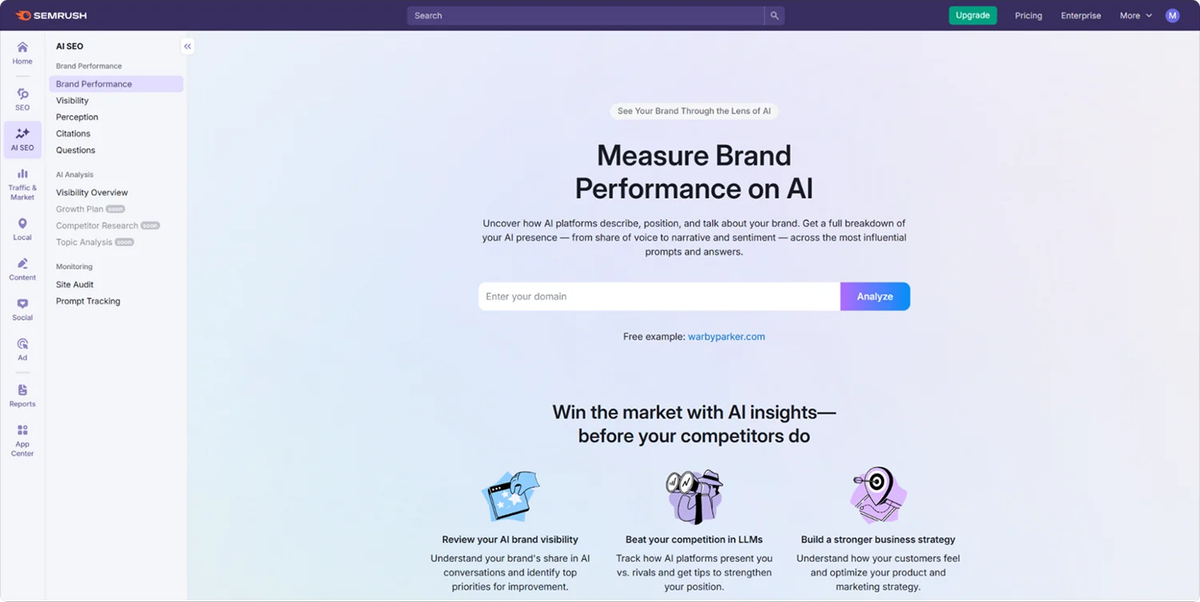
Semrush's AI Visibility Toolkit combines research into AI mentions with tracking for your own questions. Those serve different needs: a research dataset can reveal topics to investigate, while custom prompts let you follow questions you selected over time.
The standalone offer is advertised at $99/month per domain, billed annually, with 25 custom prompts and one Brand Performance domain. Custom Prompt Tracking updates daily; Brand Performance updates weekly. User access, extra domains and prompts can affect the total. Semrush also offers SEO and AI Search bundles.
For an existing customer, first inspect what your account already includes and what an upgrade adds. Keeping Peec for a selected prompt set while using Semrush for wider topic research may be useful; paying for overlapping monitoring may not be.
Compare the exact reports you need, not just the shared “AI visibility” label. A broad research view does not replace a client-specific question set, and a custom tracker does not automatically provide the same discovery dataset.
More specialized options
SEOmonitor: keyword-led AI reporting beside Google performance
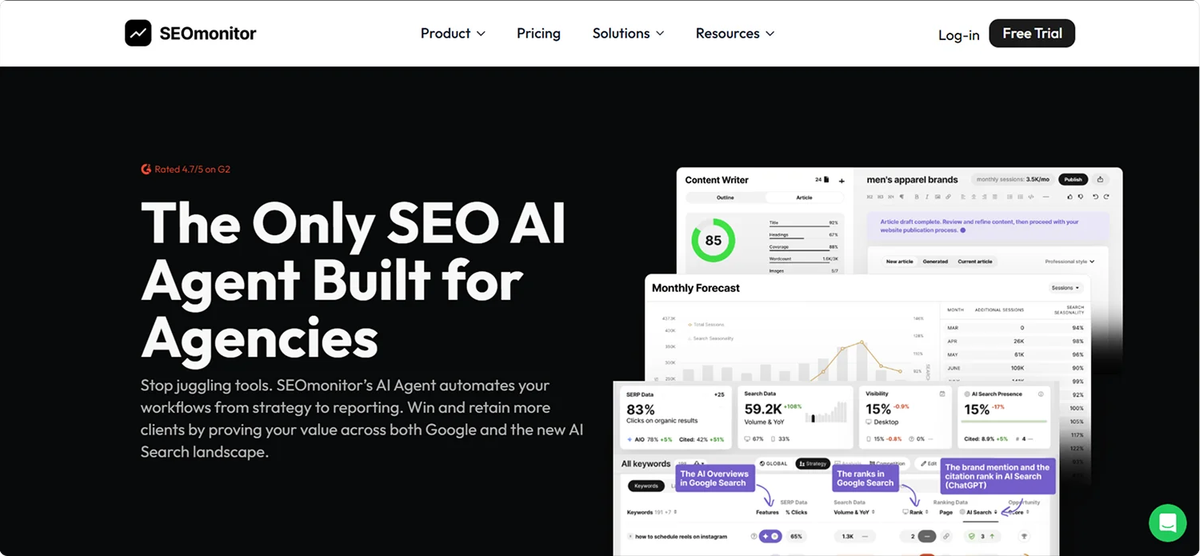
SEOmonitor is relevant if your team wants Google rankings, AI Overviews and assistant tracking in an SEO reporting workflow. It describes daily AI Overviews tracking and weekly AI Search tracking across ChatGPT, Claude, Gemini and Perplexity.
Displayed base prices start at €99/month for Starter and €299 for Pro; AI Search keyword allocation is configurable. Pro lists API access, Looker Studio and MCP beta. Price the selected AI allocation rather than treating the base SEO keyword count as included AI prompts. Its writing and CMS publishing features are a separate reason to evaluate the suite.
Goodie: monitoring with content and optimization support
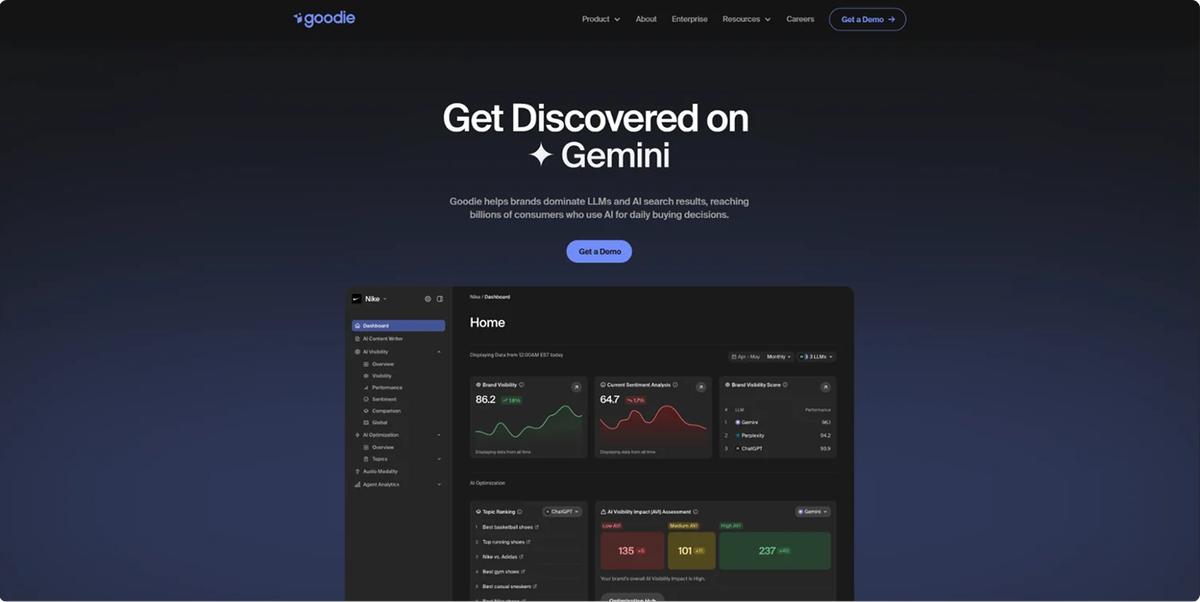
Goodie combines monitoring with Content Studio and optimization actions. Core is advertised at $295/month with 110 prompts and five models; Pro at $999 with 250 prompts and eight models. Establish the billing commitment attached to the offer before comparing it with a cancellable monthly plan.
For a larger portfolio, check how many brands, countries and languages the plan covers as well as how many prompts you can track. If your writing process already works well, content features alone are not a reason to leave Peec.
Atomic AGI: analytics and agents priced per project
Atomic AGI brings AI Search analytics, citations, mentions, sentiment and agents into a project-based subscription. It offers a free tier, Starter at $40/month per project and Team at $100/month per project, with different model and usage allowances.
The per-project structure is useful to consider for a focused setup. For a portfolio, include every required project in the cost. Evaluate how often the selected plan refreshes your questions and what data you can retain or take into reports; the lowest per-project price alone does not establish a cheaper replacement for Peec.
Morningscore: focused ChatGPT tracking within an SEO suite
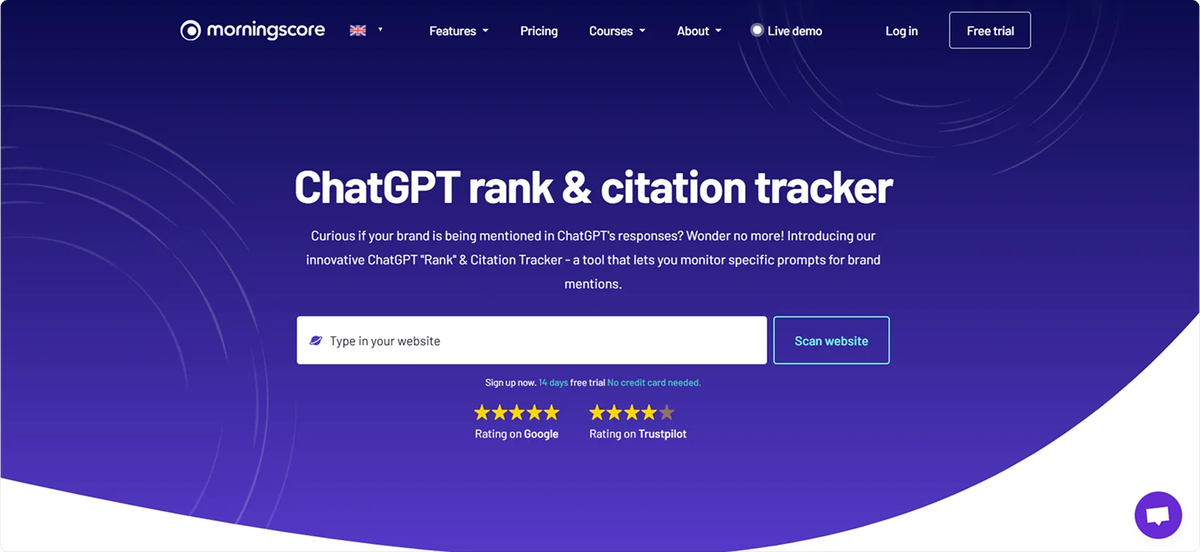
Morningscore's ChatGPT tracker records mentions and citations, lets you inspect results and checks selected prompts weekly. Its pricing lists Lite at $69/month, Business at $99, Pro at $159 and Premium at $299, alongside SEO tools and shared AI-credit allowances.
Consider Morningscore when you want SEO tools alongside AI Search tracking. It checks your custom ChatGPT questions weekly and tracks Google AI Overviews daily for selected keywords. That may be enough if those are the platforms your team needs. Compare the coverage and update frequency with Peec, and keep Morningscore's AI credits separate from its allowance for regularly tracked ChatGPT questions.
Brandwatch: AI Search alongside broader consumer intelligence
Brandwatch's Search Intelligence, powered by Trajaan, combines AI Search monitoring with research into consumer demand across traditional search, social and shopping platforms. It helps teams examine how AI answers mention brands and competitors, alongside wider changes in what people search for.
It is worth considering when an enterprise insights team wants to connect AI Search findings with broader consumer research. If you need it to replace Peec's recurring monitoring, confirm the supported engines, questions, reporting access and exact AI answers available in your proposed package.
Check the current XFunnel and HubSpot buying route
HubSpot announced its XFunnel acquisition, and its current AEO product advertises a $50/month standalone offer for monitoring and recommendations. For a team already working in HubSpot, that is worth evaluating against another subscription. Check current coverage and access rather than assuming the old XFunnel service, analyst support and the HubSpot offer are identical.
Choose Peec, upgrade it, connect a tool or replace it
For one brand, start with the questions and engines that matter
Peec may already cover your daily reporting and source-investigation needs. If you are starting fresh, use the same small set of meaningful questions in each trial and inspect the actual answers, sources and competitor results.
If your existing Peec subscription falls short on prompt volume or engines, compare its upgrade and add-on costs with the alternative that covers the same work. If the gap is writing or SEO research, an additional tool may be more useful than replacing analytics.
For an agency, test the client report and access
For agencies, check whether clients can access only their own data, whether reports are easy to share and how prompt capacity is divided across client projects.
Compare Peec's agency package with the appropriate alternatives' client allowances and reporting access. A plan that permits many brands can still have too few prompts for the portfolio. Run through one real client-reporting task in a trial before migrating every account.
For an enterprise, test the connection and market coverage
An API lets another system retrieve data automatically. A reporting connector may cover a simpler need, such as feeding a Looker Studio dashboard. Choose the connection your team needs rather than treating API access as a benefit in itself.
Compare Peec's applicable package with the alternative's required tier, including engines, countries, languages, permissions and retained history. Ask for a sample of the data that would feed your report. A dashboard export may be sufficient; a larger subscription is justified when the recurring work needs it.
Separate the need to measure from the need to act. A team may keep Peec and connect a content workflow, while another chooses a platform that also drafts content. In either case, identify who approves changes and who publishes them.
What to preserve before switching
Before closing an account, save the prompt list, topics, country/language settings, competitor set and brand aliases. Keep available reports and answer/source exports in a form your team can still use. Check the current export permissions before relying on a particular field or file format.
Rebuild the reporting connections and access your colleagues or clients depend on. Test a manageable portion of the setup first. A migration is incomplete if the dashboard works but the monthly report no longer does.
Start a new measurement baseline in the replacement tool. Vendors may collect different answers, use different schedules or calculate scores differently. Keep historical reports for context; do not join the old and new scores as if they were one uninterrupted series. For more detail, see our guide to API and UI data collection.
Make the trial answer a real buying question
Choose one requirement that matters to your team: a usable client report, a particular market, an automatic data feed or content work with an approval step. Test that requirement through to completion.
If Peec meets it with a suitable plan or connection, it may be the right choice. If another product makes that work easier at an acceptable total cost, you have a concrete reason to change. For a closer look at one engine, see our ChatGPT tracking tools guide.
To evaluate Superlines, start a trial with questions your team already uses and compare how easily you can investigate answers, explain competitor differences and take findings into your reporting workflow.