


WebMCP is an emerging web standard designed to make website functionality easier for AI agents to understand and use.
Instead of forcing a browser agent to interpret screenshots, locate buttons, fill fields, and work out how an interface functions, a website can expose selected actions as structured tools. An agent can then understand what those tools do, what information they require, and how to invoke them.
That makes WebMCP potentially important as browsers become more agentic.
But there is an important distinction: WebMCP is not the same thing as an MCP server, and there is currently no established evidence that implementing WebMCP improves your visibility or citation rate in AI search engines.
This guide explains what WebMCP actually is, how it differs from the Model Context Protocol, where it could be useful, and what brands should realistically do about it today.
What is WebMCP?
WebMCP is a proposed browser API that allows websites to expose functionality as structured tools that compatible AI agents can use.
The current WebMCP work includes both JavaScript-based tools and declarative approaches that use existing web elements such as HTML forms.
In practical terms, imagine a travel website with a flight search form.
Without WebMCP, a browser agent may need to:
- Understand the page visually
- Find the departure and destination fields
- Determine how the date picker works
- Fill in the fields
- Locate the search button
- Interpret the resulting page
With WebMCP, the website could expose the same functionality as a structured "search flights" tool with parameters such as origin, destination, departure date, and number of passengers.
The agent does not need to reverse-engineer the interface. The website tells it what action is available and what information the action requires.
WebMCP is currently experimental and under active development. Its APIs, implementation details, and browser support can still change.
What is the Model Context Protocol, or MCP?
The Model Context Protocol is an open standard for connecting AI applications with external systems, tools, and data.
Anthropic introduced MCP in November 2024 as an open standard for connecting AI assistants to systems such as content repositories, business tools, and development environments. You can read Anthropic's original announcement here: Introducing the Model Context Protocol.
An MCP server can expose capabilities such as:
- Tools that an AI model can invoke
- Resources that an application can retrieve
- Prompts or reusable interaction templates
- Structured outputs from connected applications
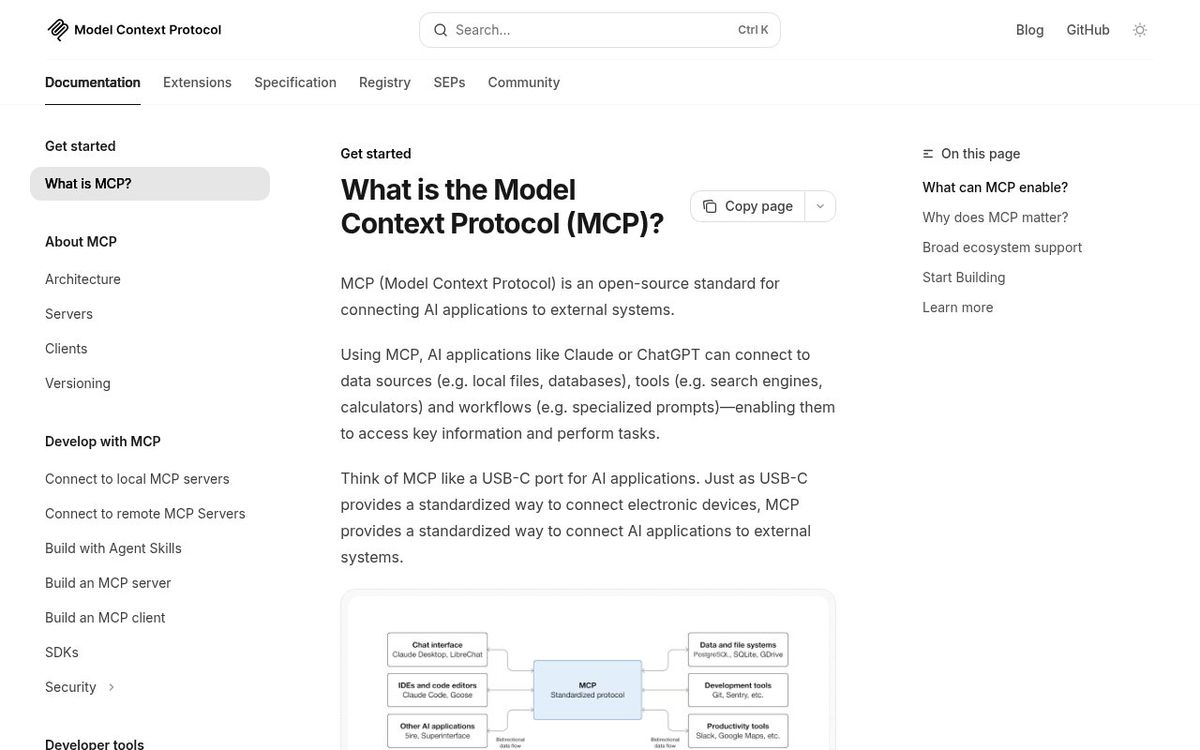
For example, a CRM could operate an MCP server that allows a compatible AI application to search customers, retrieve an account, or create a task.
An analytics platform could expose tools for retrieving performance data.
A developer platform could expose documentation, project information, or actions.
The important point is that the AI application connects to the MCP server directly. It does not need to navigate the company's website in the same way a human would.
This is how products such as Superlines can make their software capabilities available to AI agents and AI applications independently of the normal application interface.
WebMCP vs MCP server: what is the difference?
This is the distinction that is easy to miss.
A simple way to think about it is:
MCP makes software accessible to AI applications. WebMCP makes website functionality accessible to browser agents.
There is some conceptual overlap, but they solve different problems.
WebMCP should not be understood simply as "putting an MCP server on your website."
A practical example: Superlines MCP vs WebMCP
Superlines has an MCP server that can make Superlines capabilities available to compatible AI clients.
An AI application could, depending on the tools exposed and the user's permissions, interact with Superlines data and functionality through that MCP connection rather than manually navigating the Superlines interface.
That is regular MCP.
A WebMCP implementation would be different.
For example, imagine that functionality inside the Superlines web application were exposed to a browser agent as structured tools. While a user had Superlines open, the browser agent might understand that the page offers actions such as selecting an organization, configuring an analysis, or filtering a report without relying entirely on visual interpretation of the interface.
That would be a WebMCP use case.
The distinction is important because the technical architecture, user experience, and potential benefits are different.
How does WebMCP work?
The current WebMCP work includes two main approaches.
1. Imperative WebMCP
Web developers can use JavaScript to register structured tools.
A tool can describe:
- Its name
- What it does
- What parameters it accepts
- The schema for those parameters
- The JavaScript functionality that should execute when the tool is called
This is useful for website functionality that already depends on JavaScript.
Examples could include:
- Searching a product catalog
- Changing application state
- Navigating to a particular part of an application
- Configuring a product
- Running a calculator
2. Declarative WebMCP
WebMCP is also exploring a declarative approach built around ordinary HTML.
For example, a developer can annotate an HTML form with information describing the tool and its parameters. The browser can then translate the form into a structured representation that an agent understands.
This could make WebMCP particularly relevant for existing website interactions such as:
- Search forms
- Product filters
- Reservation forms
- Quote requests
- Comparison tools
- Checkout-related steps
- Configuration interfaces
Instead of replacing the website interface, WebMCP can make the functionality behind that interface more explicit to agents.
Why does WebMCP exist?
Browser agents can already interact with websites.
The problem is reliability.
An agent that operates a website purely through visual interpretation may need to determine what elements mean, which controls are interactive, what information a field expects, and what action should happen next.
Modern web interfaces can make this difficult.
Buttons move. Interfaces change. Elements can be visually ambiguous. Custom controls can behave differently from standard HTML components.
Structured tools give the website itself an opportunity to tell the agent:
This is what I can do, these are the inputs I need, and this is how you can invoke the function.
The objective is therefore less about making a website "rank for AI" and more about making website interactions easier for compatible agents to perform reliably.
Does WebMCP improve AI Search visibility?
There is currently no established evidence that implementing WebMCP increases a website's visibility in ChatGPT, Google AI Overviews, Gemini, Perplexity, Copilot, or other AI search experiences.
That distinction matters.
WebMCP is designed primarily around agent interaction with websites, not around search engine crawling or ranking.
AI search visibility typically involves separate processes such as:
- Discovering pages
- Crawling or retrieving content
- Understanding the information on those pages
- Selecting relevant passages or sources
- Generating an answer
- Deciding which sources to cite or link
If your objective is improving visibility across systems such as ChatGPT, Gemini, and Copilot, the more relevant discipline today is generative engine optimization, which focuses on understanding how brands and content appear across AI-generated answers.
You can also monitor individual platforms using dedicated visibility tracking approaches, including ChatGPT rank tracking, Gemini rank tracking, and Copilot rank tracking.
WebMCP gives compatible agents structured ways to perform actions on a website. That does not mean an AI search system will rank the website more often, mention its brand more frequently, or cite its pages.
That could change as agentic search products develop, but it should currently be treated as a possibility rather than an established GEO tactic.
Does WebMCP increase AI citations?
There is also no established evidence that adding WebMCP to a website increases AI citation rate.
A structured tool could help an agent retrieve accurate information during an interaction. But retrieval, attribution, and citation are separate things.
An agent successfully retrieving a product price through a structured tool does not necessarily mean that:
- The brand will be mentioned in an AI answer
- The website will receive a link
- The tool response will appear as a citation
- The page will rank more prominently in future AI search results
Those behaviors depend on the AI application, its retrieval system, and how it handles sources and attribution.
For brands working on generative engine optimization, WebMCP should therefore currently be viewed as an agent-readiness technology, not a proven citation optimization technique.
Is WebMCP replacing crawling?
No.
WebMCP and web crawling solve different problems.
Crawling allows search engines and other systems to discover and retrieve information published on the web.
WebMCP allows compatible agents to understand and invoke functionality exposed by a webpage.
A company may therefore have all of the following at the same time:
- Crawlable HTML pages
- Schema.org structured data
- Public APIs
- An MCP server
- WebMCP-enabled website functionality
Each serves a different purpose.
A WebMCP implementation does not remove the need to publish useful, accessible, crawlable content.
How does WebMCP compare with structured data?
Schema.org structured data and WebMCP are also different.
Structured data describes information on a page in a machine-readable format.
For example, JSON-LD might describe:
- A product
- Its price
- Its availability
- An organization
- An article
- An event
WebMCP describes tools and functionality that an agent can invoke.
A useful distinction is:
Structured data helps machines understand information. WebMCP helps agents understand what they can do.
There can be interaction between the two, but one does not replace the other.
How does semantic HTML fit in?
Semantic HTML solves yet another problem.
Elements such as headings, lists, tables, forms, buttons, navigation landmarks, and descriptive labels give machines and humans clearer information about the structure and meaning of a webpage.
For AI Search, this matters because clean page structure can make important information easier to discover, parse, and retrieve.
We cover this in more detail in our guide to semantic HTML and AI visibility.
Semantic HTML and WebMCP can complement each other:
- Semantic HTML makes the underlying webpage clearer.
- WebMCP can make specific actions available as structured tools.
Neither should be treated as a replacement for useful content.
What about llms.txt?
llms.txt is another separate concept.
It is a proposed convention for providing LLM-oriented information about a website and pointing models toward useful resources.
It is not part of MCP or WebMCP.
More importantly, the existence of an llms.txt file should not be treated as a prerequisite for AI search visibility. Evidence that it materially increases brand visibility or citation performance remains limited.
This is why it is useful to separate several technologies that are often grouped together under "AI readiness":
- Semantic HTML: makes page structure clearer and more accessible
- Schema.org: describes entities and information using structured data
- llms.txt: proposes an LLM-oriented site information layer
- MCP: connects AI applications directly to tools and data
- WebMCP: exposes webpage functionality to compatible browser agents
They may coexist, but they are not successive versions of the same technology.
Where could WebMCP be useful?
The most compelling WebMCP use cases are likely to involve websites where users do something, rather than websites that are primarily read.
E-commerce
An e-commerce site might expose structured tools for:
- Searching products
- Filtering products by attributes
- Checking availability
- Comparing variants
- Configuring a product
An agent could potentially use those tools rather than reproducing the same workflow through visual browser interaction.
Travel and booking
Travel websites have complex forms involving locations, dates, passengers, rooms, and filters.
These are natural candidates for structured agent interactions.
SaaS applications
Web applications could expose selected interface functions to browser agents, allowing users to delegate multi-step workflows while remaining inside the application.
Calculators and interactive tools
Mortgage calculators, configurators, assessment tools, comparison engines, and other interactive experiences could expose their inputs and actions explicitly.
Forms and lead-generation workflows
A website might make actions such as requesting a quote or finding an appropriate service easier for an agent to understand.
This does not mean every one of these implementations makes sense today. Browser and agent support remains an important limitation.
Who should experiment with WebMCP today?
WebMCP is still emerging, so implementation should start with the user problem rather than with an assumption about SEO benefits.
It may be worth experimenting now if:
- Your website contains complex interactive workflows
- Users could reasonably delegate those workflows to an AI agent
- Visual automation is currently fragile or cumbersome
- Your development team wants to experiment with browser-agent interfaces
- You can identify a specific action where structured invocation would improve the experience
It is probably lower priority if:
- Your website is primarily informational
- Most of your important content is static
- Your main objective is increasing AI search visibility
- You do not have a concrete agent interaction you want to enable
For a content publisher, for example, improving the quality, originality, accessibility, and structure of the content is currently much more directly connected to AI search discovery than implementing WebMCP.
What should brands do about WebMCP today?
For most organizations, there is no need to treat WebMCP as an urgent GEO checklist item.
A more useful approach is:
1. Understand whether you actually have an agent interaction problem
Look for workflows users may eventually want to delegate.
Examples include:
- Finding a suitable product
- Configuring a service
- Searching inventory
- Booking an appointment
- Completing a complex form
- Running an interactive calculation
If your website does not contain meaningful interactive workflows, WebMCP may offer little immediate value.
2. Get the web fundamentals right first
WebMCP does not replace good website architecture.
Continue investing in:
- Useful and original content
- Semantic HTML
- Crawlability
- Accurate structured data
- Clear information architecture
- Accessible interfaces
- Fast and reliable pages
For AI Search specifically, these fundamentals currently have a much clearer relationship with content discovery and retrieval than WebMCP does.
3. Separate your MCP strategy from your WebMCP strategy
If your goal is to let AI applications access your software, data, or actions directly, an MCP server may be the more relevant technology.
If your goal is to make functions on your website easier for browser agents to operate, WebMCP may be relevant.
Some companies may eventually use both.
4. Experiment with one clearly defined tool
Rather than exposing an entire web application, identify one interaction that is valuable and easy to test.
For example:
- Search products
- Find available appointments
- Calculate a quote
- Configure a plan
Measure whether structured agent interaction actually makes the workflow more reliable.
5. Monitor the standard and browser support
WebMCP remains under active development.
Implementation details can change, and the value of adopting it will depend significantly on which browsers, AI assistants, and agents support it.
That makes experimentation reasonable for some companies, but broad implementation based purely on anticipated AI Search benefits would be premature.
How does WebMCP fit into GEO and AI Search optimization?
At the moment, WebMCP should sit adjacent to a GEO strategy rather than at the center of it.
If your goal is to increase visibility in AI-generated answers, the more immediate questions are still:
- Does your brand appear for the queries that matter?
- Which sources are AI systems currently citing?
- Is your information accessible and retrievable?
- Does your content provide something specific enough to use as a source?
- Are important facts, product details, pricing, comparisons, and research clearly available?
- Are competing sources providing information that your own website does not?
- Is your content current, specific, and easy to verify?
An AI search visibility dashboard can help answer those questions by showing where a brand appears, which pages are cited, and which other domains are being used as sources.
WebMCP addresses a different question:
Can an AI agent reliably use the functionality available on your website?
As browser agents become more capable, that could become an increasingly important part of the broader AI experience. But it should not currently be confused with a proven method for increasing AI search rankings, mentions, citations, or referral traffic.
WebMCP and MCP will probably coexist
WebMCP does not make MCP servers obsolete, and MCP servers do not remove the potential need for WebMCP.
A software company might eventually have both.
Its MCP server could let AI applications connect directly to its underlying tools and data.
Its website could use WebMCP so browser agents can understand and operate selected functionality when users interact with the site.
Meanwhile, the public website would still need high-quality, accessible content so search engines and AI retrieval systems can understand the company and its products.
These are complementary interfaces for different types of machine interaction.
To Summarize
WebMCP is an emerging way for websites to expose their functionality as structured tools to AI agents operating in the browser.
It is not the same as running an MCP server.
An MCP server gives compatible AI applications direct access to software tools, resources, and data. WebMCP makes functionality available from within the web environment so compatible browser agents can interact with it more reliably.
And importantly, there is currently no established evidence that WebMCP by itself increases AI search visibility or citation rate.
For companies focused on GEO today, the priority should remain producing useful and original information, making important content accessible, understanding which sources AI platforms currently retrieve and cite, and measuring brand visibility across the queries that matter.
For companies building toward a more agentic future, WebMCP is worth watching and, where there is a concrete browser-agent use case, worth experimenting with.
The opportunity is not simply to make websites easier for AI to read.
It is to make websites easier for AI agents to use.
Use AI Search data directly inside your AI assistant
If you're looking for an AI Search platform that can also work directly with AI assistants such as ChatGPT or Claude, Superlines includes an MCP server that lets compatible AI applications access your AI Search data and tools directly.
That means you can bring Superlines visibility, citation, competitor, and content data into the AI workflows you already use, rather than limiting your analysis to a separate dashboard.
Today, around 70% of Superlines customers use the MCP server as part of their workflows, making it one of the most widely adopted ways our customers work with Superlines data.
Explore Superlines today!